
From Data to Action: Equitable Home Energy Labeling at Scale
VIDEO
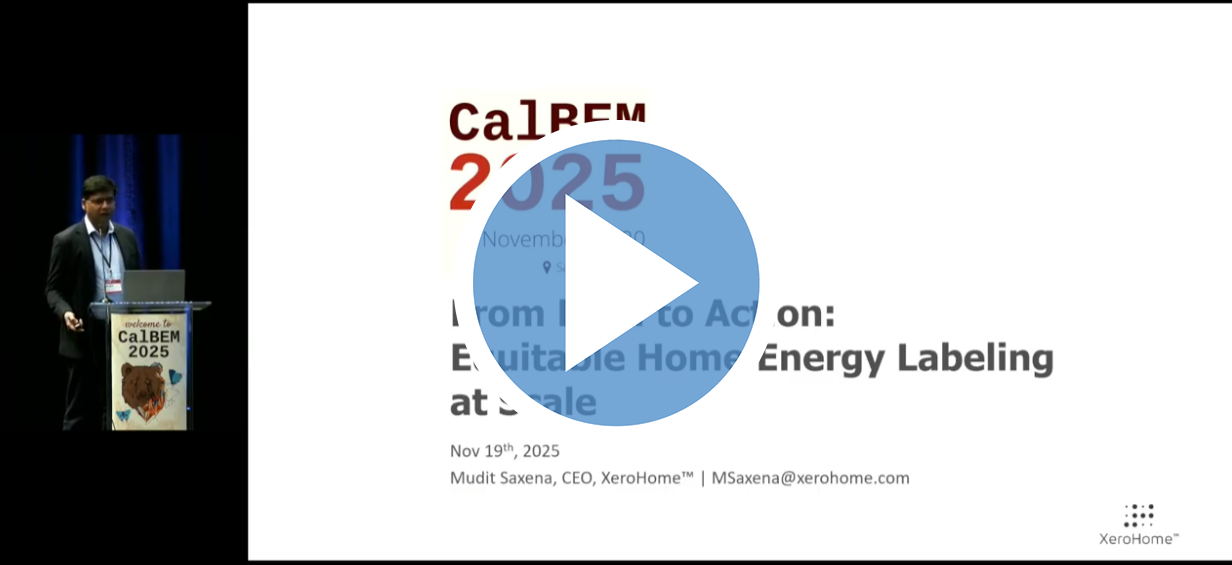
Watch XeroHome CEO Mudit Saxena present on “From Data to Action: Equitable Home Energy Labeling at Scae" at CalBEM 2025.
At CalBEM 2025 in Sacramento, XeroHome CEO Mudit Saxena delivered a technical presentation titled “From Data to Action: Equitable Home Energy Labeling at Scale,” focused on a central question facing California: how to design a home energy rating and labeling program that is feasible to implement, accurate in its results, and scalable across millions of homes.
The talk moved beyond conceptual discussions and drew directly on seven years of real-world deployments, examining what has—and has not—worked when energy modeling is applied at scale.
The Equity Imperative
California’s housing stock is extraordinarily diverse, spanning climates, vintages, sizes, and household behaviors. A key message of the presentation was that a statewide energy label must be universal and free to households. Programs that rely on optional participation or high-touch assessments risk excluding large segments of the population and reinforcing existing inequities.
If only some homes are labeled, the market signal becomes distorted—and the homes that most need guidance are often left out.
Why Usage Alone Isn’t Enough
The presentation addressed a common misconception: that utility usage data alone can be used to rate homes. While usage data are valuable, they conflate consumption with efficiency. Home size, occupant behavior, and year-to-year weather variability can all obscure the underlying performance of the building itself.
The conclusion was straightforward: usage alone cannot deliver a fair or durable efficiency rating.
A Proven Hybrid Approach
Saxena presented results from XeroHome deployments across more than a dozen cities and multiple utility regions, using a hybrid method that combines:
Physics-based building energy models built from public data
Measured utility energy data to calibrate those models
Optional homeowner inputs to further refine assumptions
This approach preserves physical transparency while materially improving accuracy—something black-box machine learning models struggle to provide when applied to buildings.
What the Data Show
Across more than 100,000 homes, the analysis demonstrated that incorporating energy-use data:
Reduced systematic bias by 78%
Reduced uncertainty by 24%
Delivered strong performance across both mild coastal and extreme inland climates
Homeowner-provided inputs further improved accuracy, but were not required to achieve credible baseline results—an important finding for equitable, low-friction programs.
Implications for California
The takeaway from CalBEM 2025 was pragmatic: California already has the data, infrastructure, and technical tools needed to implement a credible statewide home energy label at scale. The challenge is no longer technical feasibility, but policy alignment with approaches that have demonstrated real-world performance.
As the conversation around home energy labeling matures, the focus is shifting from theory to execution—and from pilots to statewide impact.